
Agent Access01 / 06
Scoped agent access
Identify agents and applications through revocable credentials associated with owners, teams, environments, and access policies.
Scoped access contextAethosHub builds self-hosted software for governing how AI agents and applications access models, MCP tools, and enterprise systems. Protect credentials, enforce runtime policies, control tool permissions, and maintain auditable activity while keeping deployment and provider accounts within your environment.
Agent Access Manager is a self-hosted AI gateway and MCP security layer that governs how agents access models, tools, APIs, and internal systems. Agents and applications authenticate with scoped, revocable credentials while provider and enterprise secrets remain encrypted and hidden from agent code.
Every request can be evaluated against identity, team, model, tool, budget, rate, and guardrail policies before it is forwarded. The Private MCP Registry centralizes approved servers, while role-based access brokerage determines which agents, keys, and teams can use individual tools.
For self-hosted MCP servers, the Kubernetes MCP Orchestrator manages isolated deployments, configuration, secrets, runtime status, logs, and restart operations. Agent Access Manager records gateway activity, MCP tool calls, policy decisions, and outcomes, giving security and platform teams a consistent operational and audit trail.
 agentaccessmanager.com
One governed gateway for model and MCP access. Provider credentials remain hidden from agents.
Agent Access Manager runs in your environment between AI applications, agents, model providers, and MCP tools. Applications use an OpenAI-compatible endpoint and scoped virtual keys while the platform routes requests, protects provider credentials, enforces policies, and records governed activity.
Create revocable, provider-independent virtual keys for applications, teams, and agents. Provider credentials remain encrypted and are not returned to clients.
Connect OpenAI-compatible clients to the gateway, use model aliases, and reduce provider-specific integration changes.
Route model requests through configured providers and fail over when a provider or deployment becomes unavailable.
Enforce spend budgets and RPM/TPM limits across organizations, teams, projects, and keys.
Apply configured PII, secret, pattern, and content policies to requests and responses with allow, flag, redact, or block actions.
Register remote and self-hosted MCP servers and control which agents, teams, and keys may access individual tools.
Maintain searchable gateway and MCP activity records for operational investigation, security detection, and response workflows.
 apikeyops.com
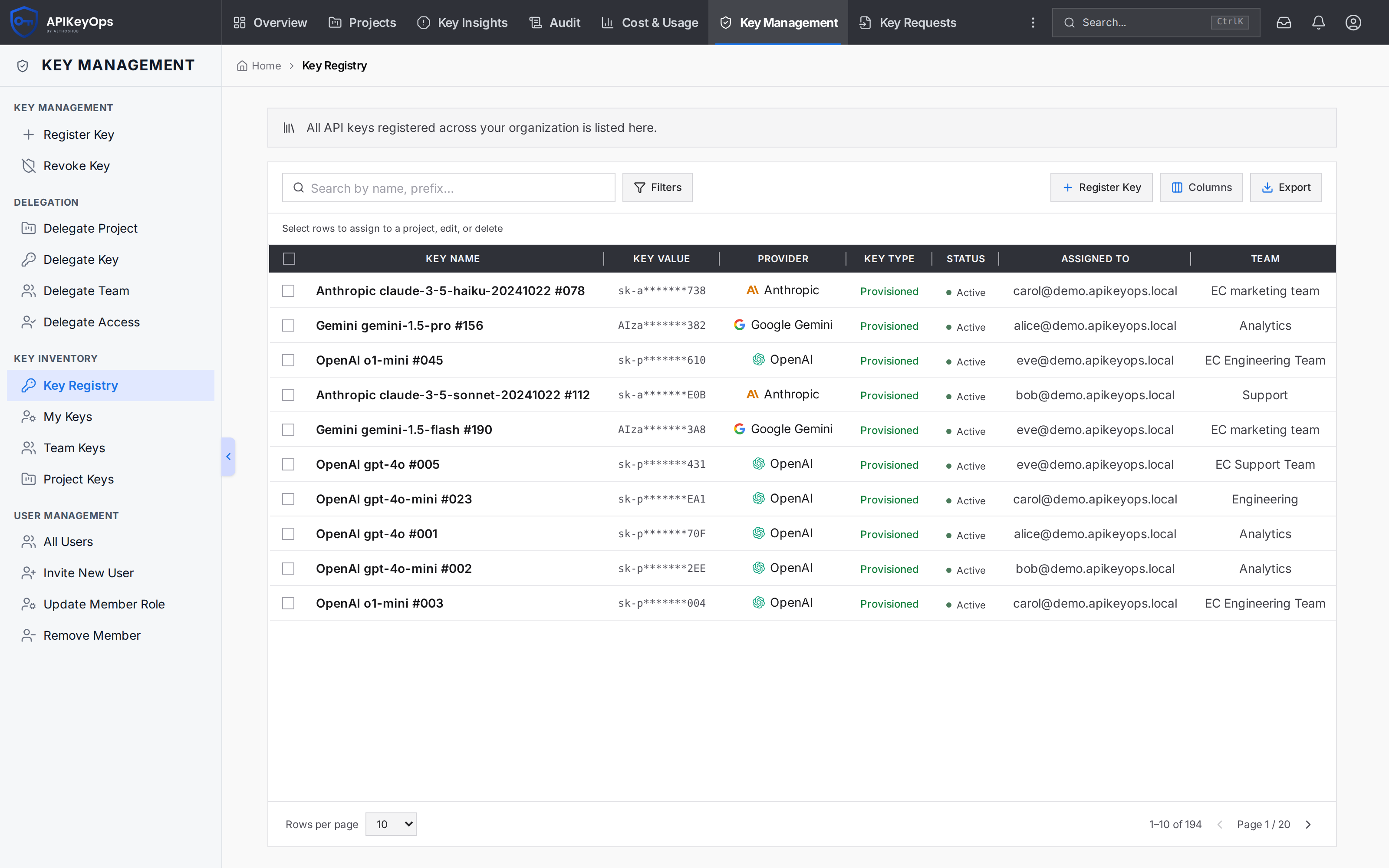
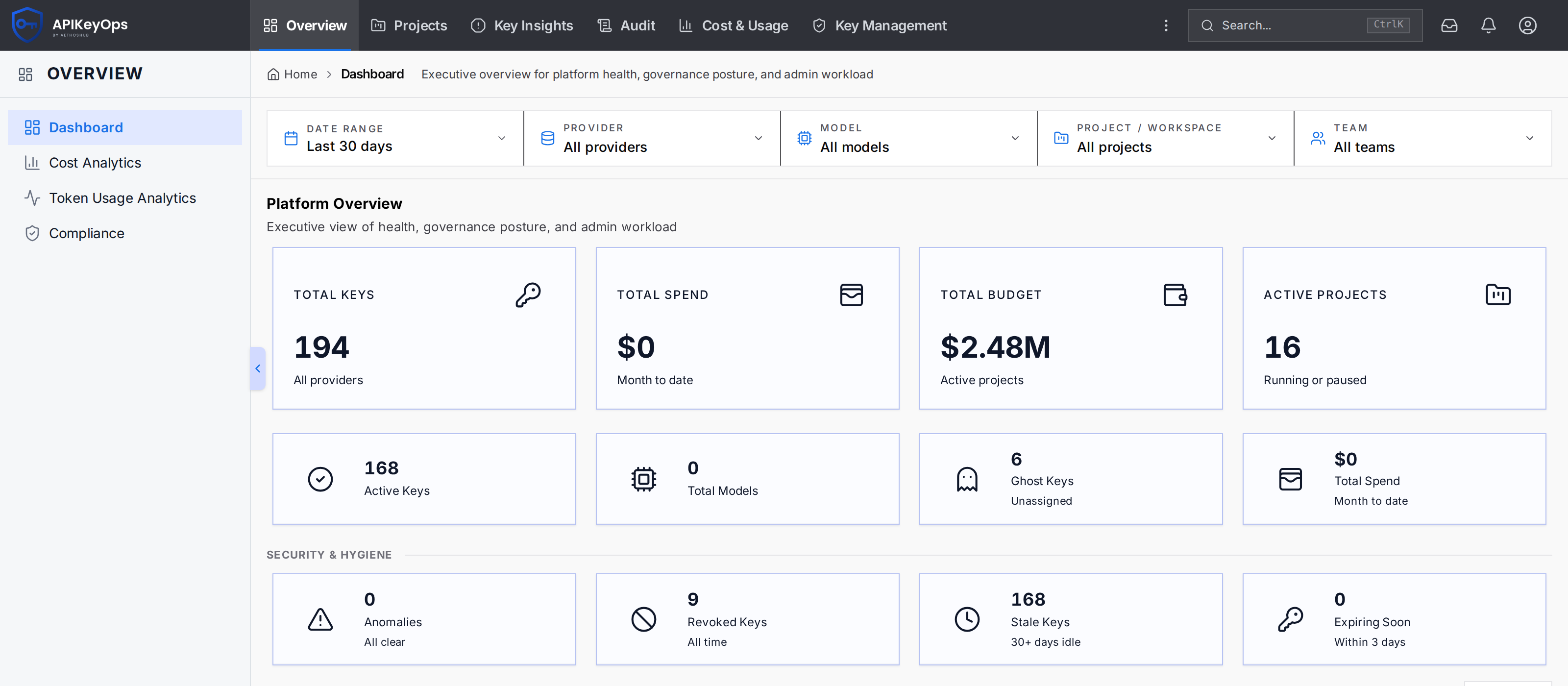
Centralize ownership and lifecycle visibility for enterprise AI credentials.
APIKeyOps provides a governed inventory of provider credentials, their owners, lifecycle status, and available usage information. It helps security and platform teams identify unmanaged credentials, assign accountability, and maintain an auditable operational record.
Track provider credentials as governed assets with ownership and lifecycle status.
Associate credentials with the teams, projects, and environments responsible for their use.
Attribute available provider usage and cost information to the appropriate credentials and owners.
Track expiry, rotation, stale, and revoked states where supported by the configured provider integration.
Record security-relevant credential events to support internal security and compliance reviews.
Bring supported model providers, OpenAI-compatible endpoints, and agent frameworks behind a consistent gateway. Centralize routing, credentials, policies, and audit visibility without rebuilding governance separately for every application.
LLM Provider Support
Connect OpenAI-compatible endpoints, Anthropic, Gemini, Vertex AI, and supported self-hosted models through centrally managed provider configurations and model aliases.
Additional providers can connect through supported OpenAI-compatible endpoints.
Framework Support
Connect SDKs, frameworks, internal wrappers, and AI applications that support a configurable OpenAI-compatible endpoint.
Integration typically requires configuring the Agent Access Manager base URL and a scoped virtual key.
Talk directly with the engineers who build Agent Access Manager. We will review your model providers, agent workflows, MCP servers, deployment environment, and security requirements, then map them to a practical control architecture.
We typically respond within one business day.
 OpenAI
 Anthropic
 Azure OpenAI
 AWS Bedrock
 Google Gemini
 Vertex AI
 Cohere
 Mistral AI
 Groq
Groq Ollama
 Meta Llama
 IBM watsonx
 NVIDIA
 Databricks
 DeepSeek
 LangChain
 LangGraph
 LlamaIndex
 DSPy
DSPy Vercel AI SDK
 LiteLLM
 Semantic Kernel
 OpenAI SDK
 CrewAI